by TRA
How Can I use
35mm in the Pentacon Six?
In June 2026 I received the following
question from a Pentacon Six user:
|
Q “I recently bought a
serviced Pentacon six TL and have been using
your website as a resource and it's been very
helpful.
There's
a question I have that i haven't seen answered
on your website — forgive me if it's been asked
and answered and i just couldn't find it — which
is the use of 35mm film in the pentacon for a
wide, xpan-like exposure. Is it possible to do
this without damaging the camera? I understand
that the spacing will be off and I'm fine with
that, but I don't want it affecting future 120
rolls and ruin the spacing for them. So, will
shooting rolls of 35mm in the Pentacon six
somehow damage the spacing mechanism?
If you
have any information on this I would really
appreciate hearing about it!
AY” |
A Hello AY
Thank you for writing. I am delighted to hear that you recently bought a serviced Pentacon Six TL, and that my website is being very helpful to you.
I realise that with such a large website it is sometimes difficult to find things, and I try to help by adding plenty of links between pages. Internet searches can also sometimes help by taking you straight to the right page.
However, this time it wasn't the absence of a link on my website or the failure of an internet search; I hadn't yet reported on how to use 35mm film in the Pentacon Six. So let's correct that now!
|
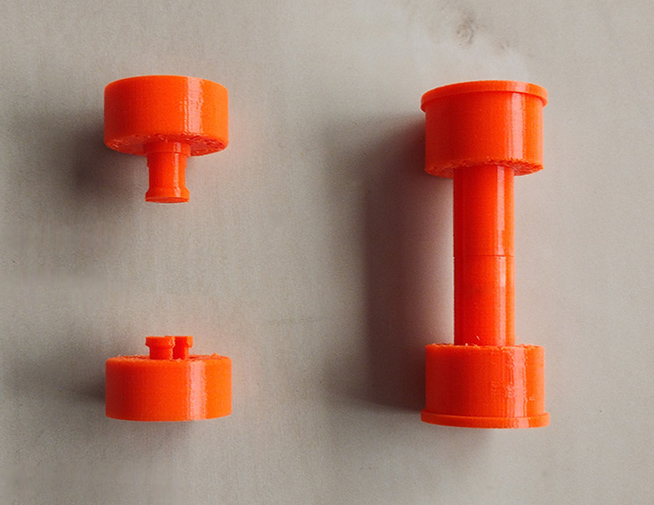 [P6_35mm_01.jpg]
|
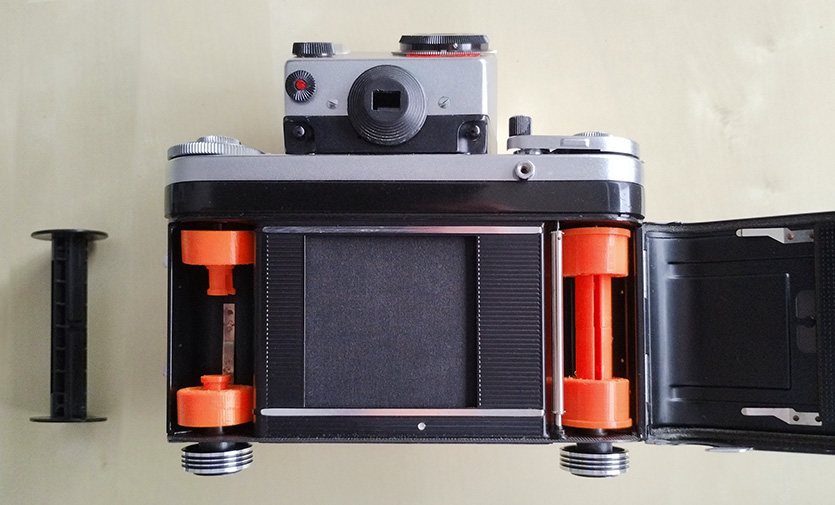
Next I show these
adapters inserted within a Pentacon Six.
|
 [P6_35mm_02.jpg]
|
If we are using 35mm
film, it will not engage with the teeth near
the top of that spindle, so precise control of
the amount of film advance is not possible,
and the user will have to guess how much to
advance the film, perhaps by inching the film
forward a number of times. If it is decided to
advance the film twice, it will obviously be
necessary to put a well-fitting lens cap onto
the front of the lens before firing the
shutter after advancing the film the first
time, in order to be able to advance it
further.
| However, using 35mm film in this way, held in place with suitable spoolholders, shouldn't damage any mechanisms in the camera, but spacing with 35mm film will probably not be accurate, with a possibility of overlapping frames. But when 120 film is loaded again, correctly, as described here and in the video linked from that page, spacing should return to normal. |
The second problem
is that, as explained here,
in cameras that use 120 film, the film is not
rewound at the end of the roll, nor indeed is
there any way to do this.
As 35mm film does not have backing paper, it
will therefore be necessary to put the camera
into a changing bag or to go into a darkroom
with no safety light on before opening the
back of the camera.
After the back has been opened, the
take-up spool (orange in the example shown
above) will need to be removed (pull down the
right-hand spool holder underneath the base of
the camera and turn it clockwise to keep it
down). Hold the orange take-up spool
carefully, so that the film does not unwind.
Then remove the feed spool and
carefully wind the film back into the
cassette, just leaving the "tongue"
(half-width initial portion) sticking out.
Only then can the film be removed from
the changing bag, or the light in the darkroom
can be turned on.
This must all be
done without a stray finger touching the
curtains of the camera shutter or damaging the
film back.
Any regular processing lab should be able to develop film, but they will almost certainly be unable to produce prints, and they should also not cut the film!
On the basis of careful inspection of the developed film, decisions on where to cut the film can be made by you, the photographer (not the lab!). Of course, one must not touch either surface of the film at any time, instead only holding it by the edges. (This of course applies to all film, including processed 120 or 220 film.)
It will then be necessary to scan the desired frames, using a suitable film or flat-bed scanner. In recent years, I have obtained excellent results scanning film with an Epson Perfection V750 PRO scanner with SilverFast software.
Some people who have experimented with using 35mm film in a Pentacon Six have produced some interesting images in which they reproduce the whole width of the 35mm film, thus showing the image that will also extend to the rebates, the sides of the film that are not normally exposed and that contain the sprocket holes and the film data information pre-exposed on the film by the film manufacturers.
XPAN cameras have the format 24 × 65mm, whereas the widest image taken with the Pentacon Six will be approximately 56mm wide. For the XPAN there is a superb 30mm lens (which needs to be used with a special filter to compensate for vignetting), whereas the widest rectilinear lens for a Pentacon Six that you are likely to find has a focal length of 45mm. For more information on this website, see here and also in the lens test reviews, here. There are also numerous 45mm shift lenses. For an introduction to these, see here. On the extremely rare 40mm lenses, for the Curtagon see three pages starting here. On the custom adaptation of a 40mm Zenza Bronica Zenzanon-S lens, see here. In addition, there is of course the 30mm Zodiak or Hartblei lens, which is superbly sharp but is a fish-eye lens that does not reproduce rectilinear images over the whole of the frame, thus requiring careful composition. See here and here.
An easier alterative is of course to shoot on 120 film but composing for a panoramic format and then to crop the result. See, for instance, here.
Click the following link to go back to
the instructions.
Click the following link to go back to the Frequently-Asked Questions.
© TRA June 2026