by TRA
Review of the Kiev 90
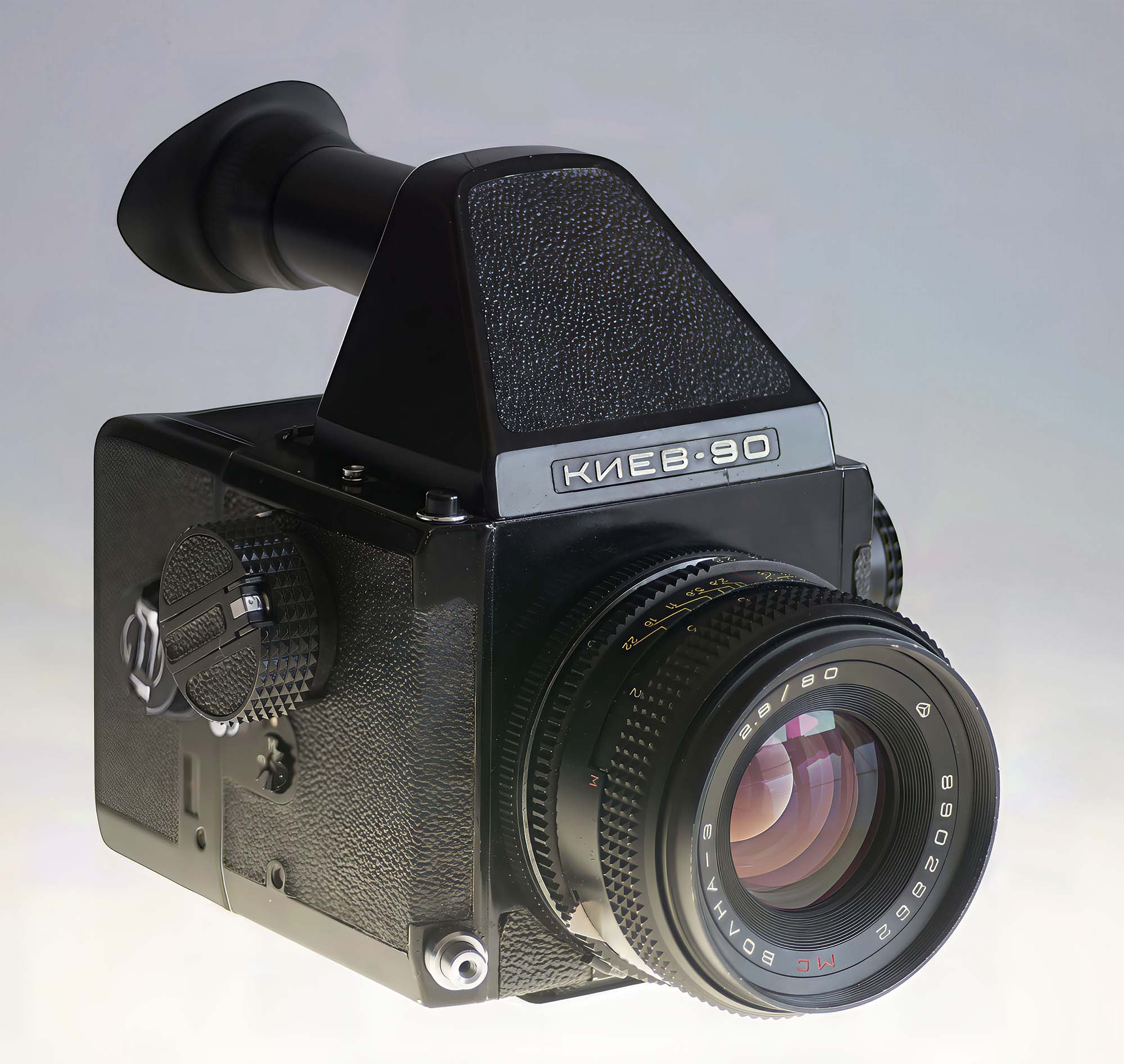
The Kiev 90
Click on image (twice if necessary with your
browser) to see it larger.
[K90_06s.jpg]
This example of the Kiev 90 shows clear signs of use, so it must once have worked, apparently for a period of years, and it was sold by a well-known seller of secondhand photographic equipment as "in full working order". It was, however, dead on arrival and was only retained because of the extreme difficulty in finding a Kiev 90 camera.
At the time, in 2015, I wrote to a leading retailer and
repairer in Ukraine of Kiev photographic equipment and
asked if they would repair it for me. The reply received
was:
"We can repair all mechanical problems. But not electronic
parts."
I replied: "Unfortunately, I believe that the problem is
electronic."
The answer that came back was:
"Electronic problems could not be repaired,
because all K-90 cameras have electronic problems. It
was an engineering mistake." (Bold added here
by me.)
Since that time the camera has been looked at by repairers
and camera experts in two countries, and they have not
been able to repair it.
Mechanically, it is jammed: the shutter cannot be cocked
or fired, and when batteries are put in, it starts to heat
up! So electronically it does not work either, which means
no shutter operation and no metering.
In spite of this, we will here look at the camera that we have before us, to see what might have been.
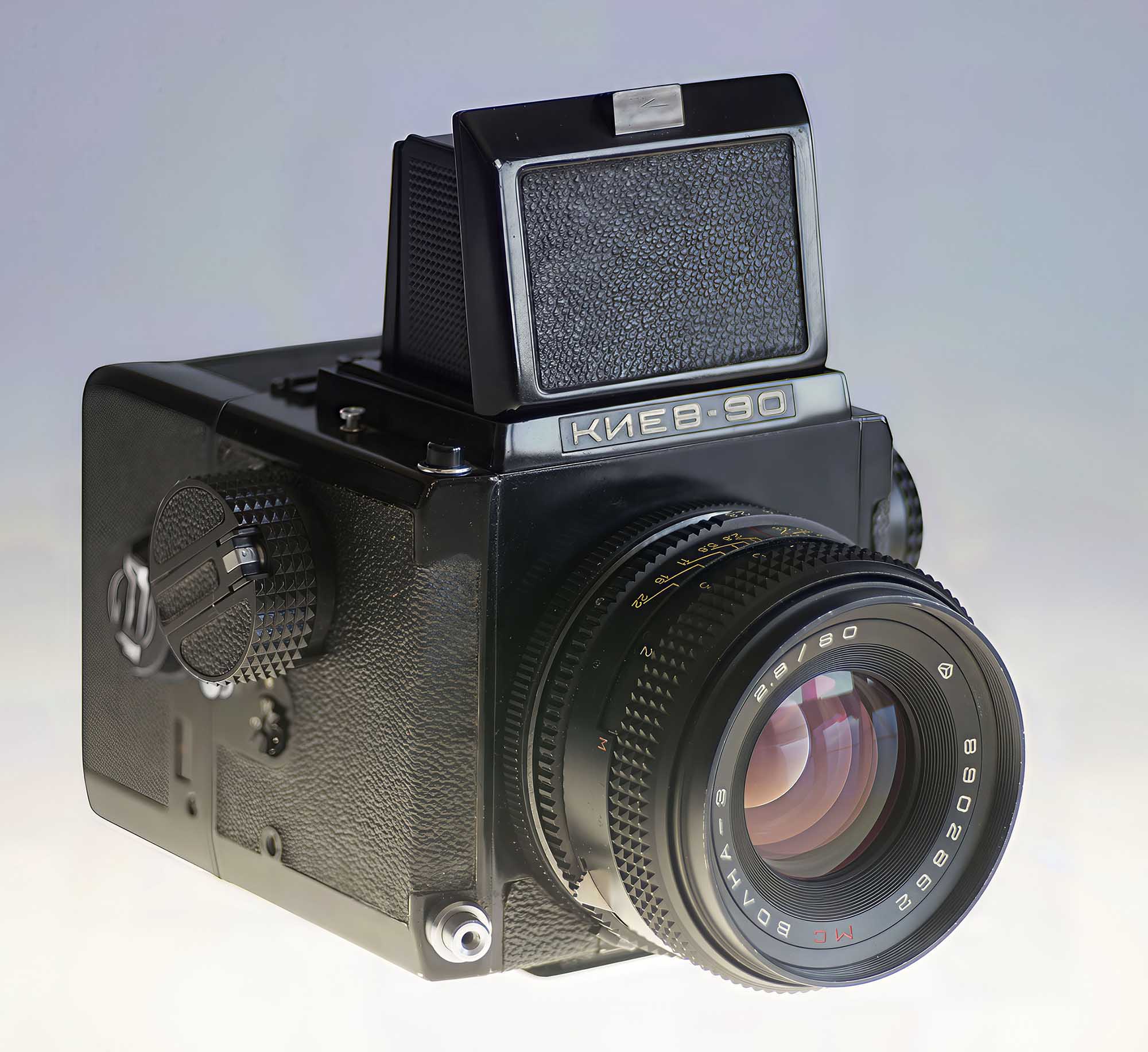 The Kiev 90 with its
waist-level finder
Click on image (twice if necessary with your browser) to see it larger. [K90_04s.jpg] |
Here we can see the camera
with its "waist-level finder".
As we saw here, Princelle gives the following information:
As we can see from the lens serial number in this picture, this particular lens was manufactured in 1989 (first two digits of serial number). The metering was within the camera body, not in the prism. Thus metering was retained, regardless which viewfinder was used. Shutter speeds are engraved on the focussing screen and when the waist level finder is used, the numbers can be seen, back to front, on the left-hand edge of the image. When the pentaprism is used, the shutter speeds are visible the right way round, on the right-hand edge of the image. The shutter speed chosen by the user, or selected by the camera in Auto mode, is apparently indicated by a light next to the corresponding speed. I say "apparently", as in this camera the lights do not come on! As the format is not square, it obviously needs to be rotated through 90º for vertical ("portrait" format) shots. Doing this while the camera is fitted with the waist-level finder is close to impossible, making the use of the prism viewfinder virtually essential. |
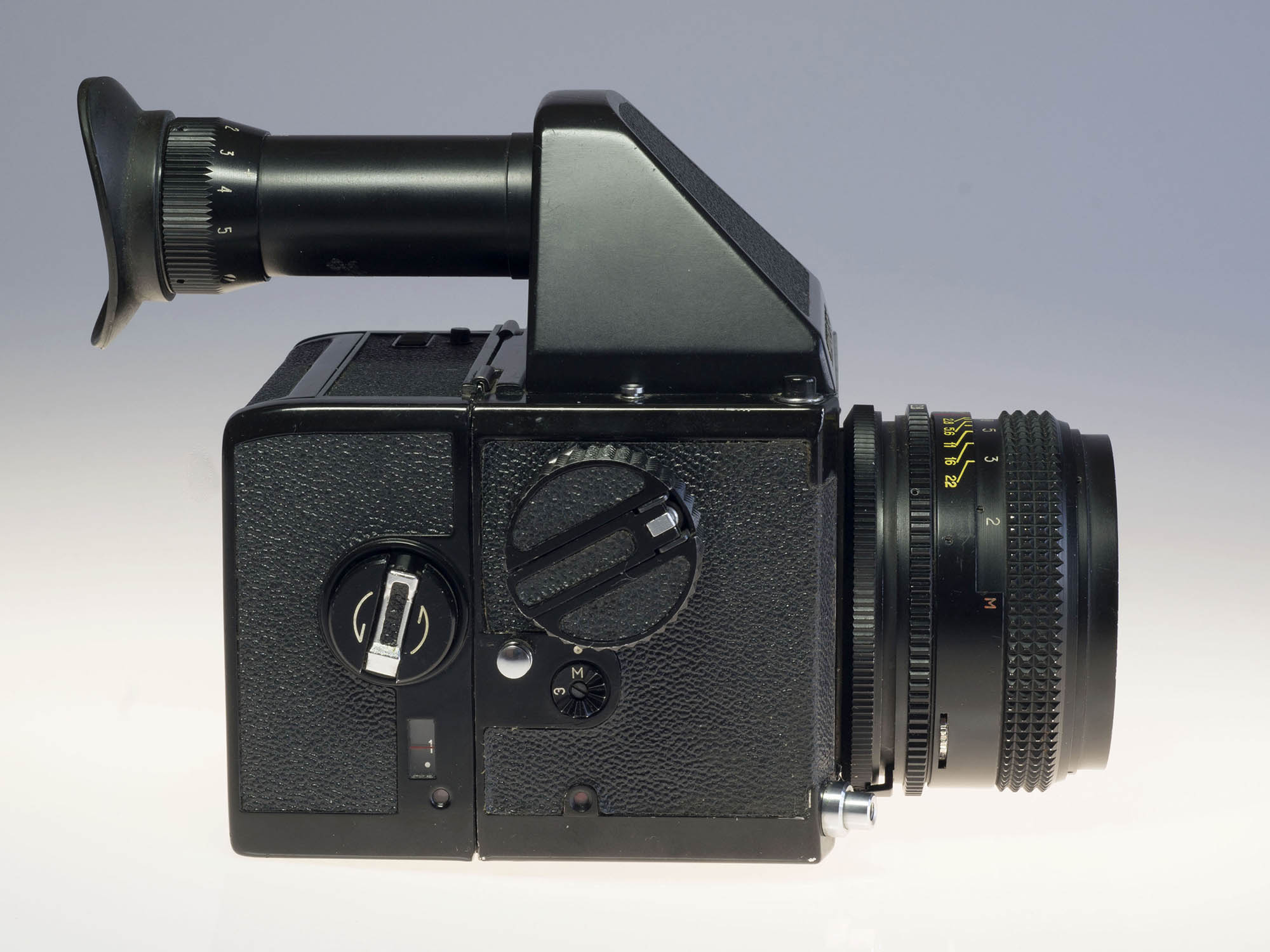 Kiev 90 right-hand side Click on image (twice if necessary with your browser) to see it larger. [K90_10s.jpg] |
This view from the right-hand
side (as seen by the user) shows the very long
tube at the back of the pentaprism viewfinder.
This is necessary because of the depth of the
camera and also the depth of the film back,
which is greater than might be expected, from
experience with other "cube-shaped" cameras.
Numbers at the back of that tube, near the eyepiece, indicate that this viewfinder has dioptric adjustment to the user's eyesight, a good detail, although on this particular example the eyepiece can easily be rotated unintentionally, resulting in a difference in viewfinder focus. Slightly more friction would be desirable here. Indeed, anyone who has used a Hasselblad 500C or 500C/M, or the Kiev copies of the original Hasselblad, the Salyut, Zenit 80 or Kiev 80 or 88, will recognise immediately the main principles underlying the design of the Kiev 90. On the body we observe the large shutter-cocking knob, which has a helpful fold-out crank. On this camera it is jammed. Beneath it we see a small control, ridged to enable it to be turned with the thumb. (The one on this camera is totally jammed!) The two index points show "3" and "M". The first character is in fact probably not the numeral "three" but the Russian letter that is sometimes known in English as "Ze". Without access to a Russian manual for the camera, I cannot be sure what Russian words are signified by these letters, but in his review of this camera in the July/August 1995 edition of the publication "The Kiev Report", Nathan Dayton states that "The switch controls the meter and electronic shutter. It has two positions: 3 and M. In the M position, the camera functions but the shutter fires at the fixed speed of 1/125. Switching to 3 lets you choose from semi-auto and automatic exposure modes." (pp. 9-10) |
|
| Behind that control is
the right-hand strap lug. Its position seems to
indicate that a strap affixed at this point would
interfere with the operation of the shutter
advance knob or crank. At the bottom of the body we can see a small, round window with a red indicator. Based on the design of the other cameras referred to above, this must indicate that the shutter has been fired. Advancing the shutter would presumably change the indicator to white. Turning our attention to the film back behind the body, we notice three components:
|
||
| Looking at the left-hand side of
the body, we notice near the top a large dial with
the following numbers on it: +2, +1, 0 (enclosed
in a frame), -1 and -2. This is obviously exposure
compensation. On the camera viewed here, this dial
can be rotated as designed (!). The function of the chrome button below this dial will be explained later. Behind this dial (to its right in this photograph), a flash shoe can be seen. Removing the plastic cover reveals that it is a hot shoe, i.e., it contains the contacts for the electronic circuit of a flashgun with a hotshoe foot. For flashguns that do not have a hotshoe foot, or when positioning the flashgun elsewhere, there is a standard "PC" coaxial socket below the left-hand strap lug on this side of the camera. To the right in this picture, we see the film back, with a dark slide inserted (notice the rectangular chrome grip for this). More on this below. Behind the dark slide we see a dial with numbers. These are reported to be the Russian "GOST" film sensitivity settings, not the ASA or DIN scales used elsewhere in the world. By default, this is locked, to prevent it being turned accidentally. Pressing the red button above the dial releases the lock, and the dial can be rotated normally (also on this camera!). The use of GOST settings, as well as Cyrillic lettering for the camera name and the lens, seems to indicate that this model was designed for sale within the USSR, not internationally. A square black button can be seen at the bottom of the back, near the camera body. The function of this button is explained below. |
|
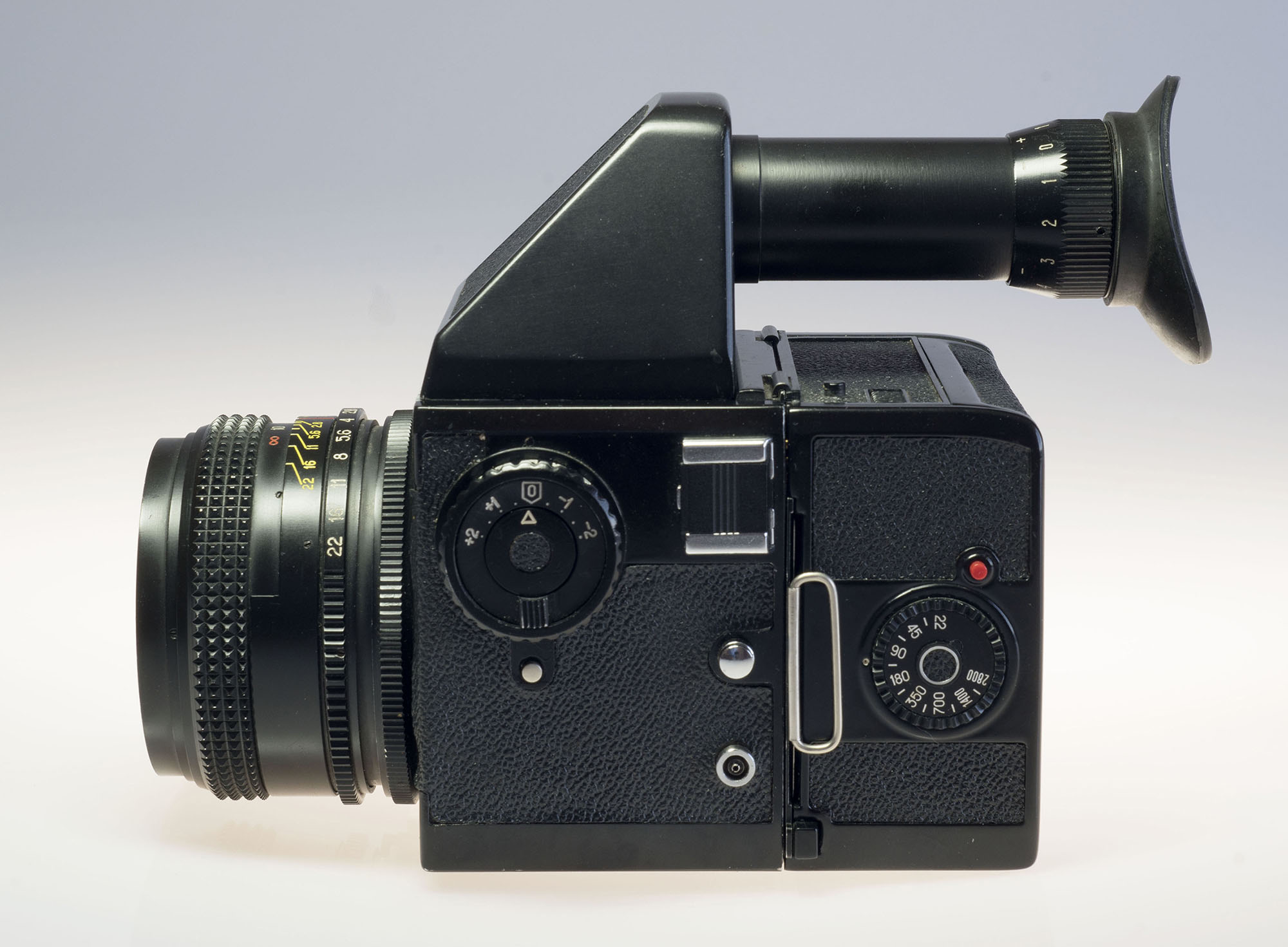 Kiev 90 left-hand side
Click on image (twice if
necessary with your browser) to see it
larger.
[K90_13s.jpg]
|
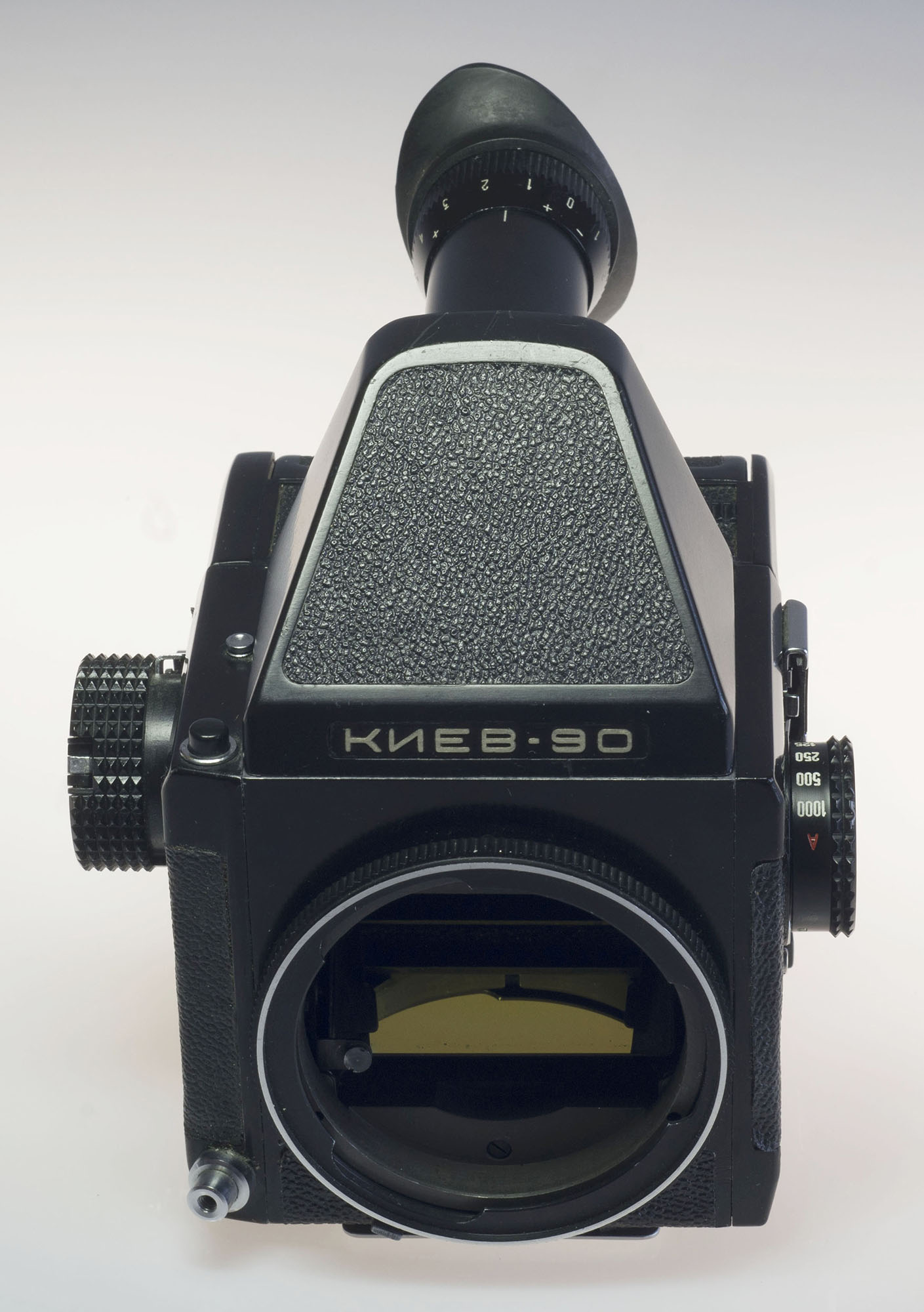 Front view of the Kiev 90
Click on image (twice if necessary with your browser) to see it larger. [K90_14s.jpg] |
|
Viewing the camera from its
front, without a lens, reveals plenty of
interesting information. On the camera top plate, to the right of the viewfinder for the user, but to its left in this photograph, we see two buttons. Starting from the back of the camera, the small chrome button unlocks the prism (in theory!), by pushing down a small pin that engages with a corresponding hole in the base of the prism or the waist-level finder. Holding down the chrome button, the prism can be slid forward and removed (without needing to remove the camera back, which is necessary with the Hasselblad models mentioned above, and with the Salyut/Zenit/Kiev 80/88 cameras). This is an improvement on the previous design. However, with this particular camera, the locking pin is too short or too low, so although the engagement of the viewfinder with the pin can be felt, it does not hold the viewfinder securely, so it can just slide off! Next on the camera top plate, in the front corner (to the right for the user, to the left in this photograph) is a small black button. This is apparently the secondary shutter release button. I say "apparently", as with a jammed shutter, it can't be tested on this camera! The main shutter release button is at the bottom front corner of the camera (again to the right for the user and to the left in this photograph). It is angled slightly out, and is threaded to accept a cable release. Moving to our right in this photograph, we can see the lens locking ring, which is very similar to the locking ring on Pentacon Six and Kiev 60 cameras, and within it, at "approximately "8.00 o'clock" in this photograph, the lever which will stop down the lens aperture when the shutter is fired. To the centre of the camera throat, we can see the lower part of the mirror, which is yellow. As we saw above, Princelle referred to a "Green-tinted mirror" with a "pink-tinted metering area". Perhaps the camera that he saw was different in this detail, or the information that he received described a different variant of the camera. In the review referred to above, Nathan Dayton states that "The metering cell, by the way, is located behind the reflex mirror. The mirror is half-silvered (it has a slight yellow cast) yet still manages to project a very bright image." I can confirm that when looking at the focussing screen, whether with the waist-level finder or the prism mounted, one sees a bright image that does not appear to be noticeably yellow. As the shutter appears to have been fired, to judge from the red indicator in the window on the side of the body, and the mirror is down, it appears that the Kiev 90 has an instant-return mirror, unlike the Pentacon Six, Kiev 60, Kiev 88 family of cameras and the Hasselblad 500C and 500C/M. To the right in this photograph, on the left-hand side of the camera, we can see that below the exposure compensation dial described above, the shutter speed knob is to be found. This is marked with the speeds "B 4c 2c" in green, where the "c" is the Cyrillic letter "s" for "seconds", then "1 2 4 8 15 30" in red, which are fractions of a second for which a tripod should be used, then, in white, "60 125 250 500 1000", which are fractions of a second for which it is normally possible to hand-hold the camera, then "A" in red. This must mean "automatic" shutter speed, which would be determined by the film sensitivity, the lighting and the lens aperture chosen. |
| On this camera I
can't see an index point against which to set
the shutter speed, but it is obviously centrally
located immediately above the shutter speed
dial. How do I know this? The shutter speed knob
clicks gently from one shutter speed to the
next, but when one rotates the shutter speed
knob to the point where the "A" is immediately
above the exposure compensation dial, there is a
clearly-audible click, and the knob locks in
this position. It can be released by pressing
the small chrome button under the knob, referred
to above, while rotating the knob away from the
"A" position. If the camera were working, I would paint an index point above the knob. Perhaps a painted dot was originally there, but it wore off in use. Making an indent for the index point would have prevented this from happening. |
||
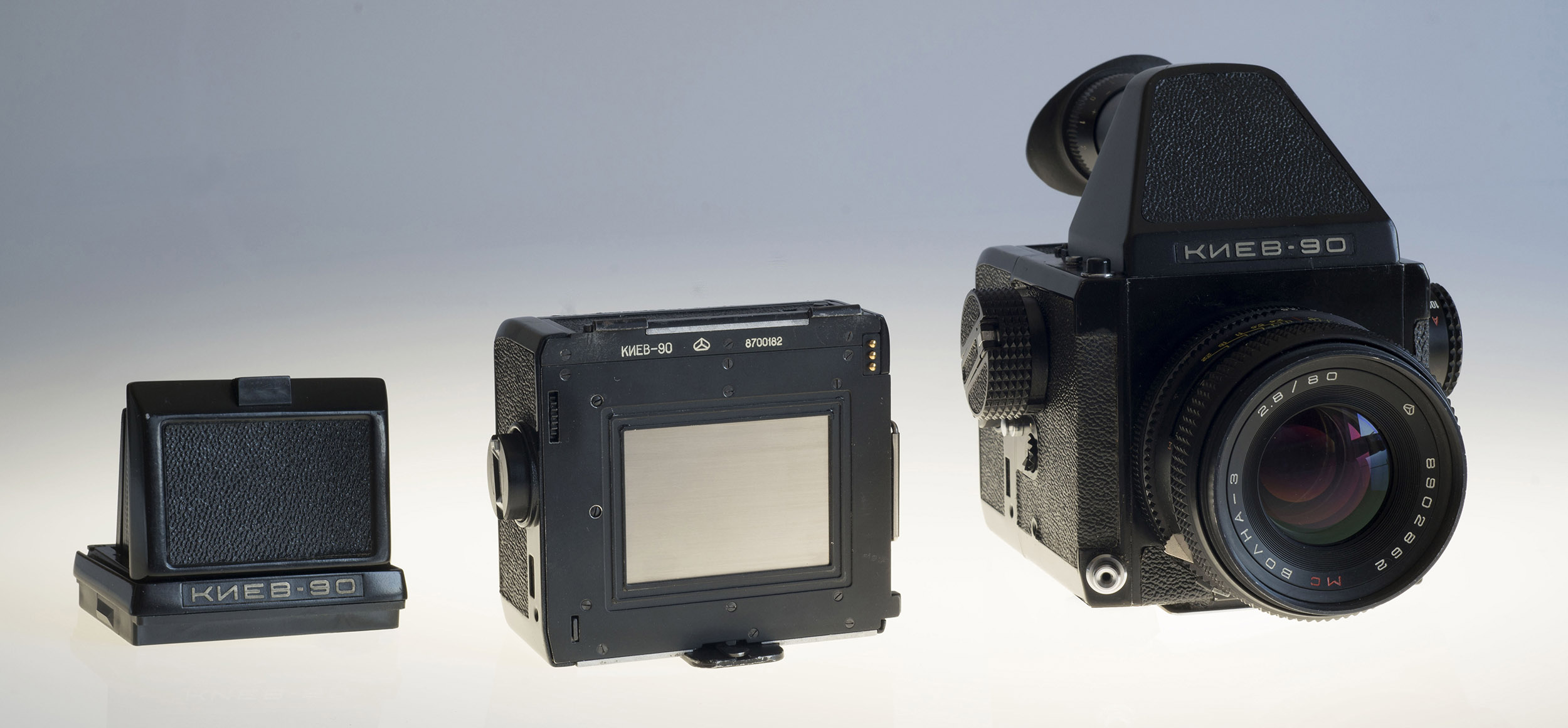 Click on image (twice if
necessary with your browser) to see it
larger.
[K90_07s.jpg]
|
|
Here we can see all the
components that I received with this camera.
From left to right: waist level finder, second
back with dark slide, camera body with standard
lens and pentaprism finder. Clicking on the image to see it larger, it will be possible to see that the serial number on the back begins with the digits "87", an indication that this back was manufactured in 1987. The other back supplied with the camera was also manufactured in 1987. The camera and the prism were manufactured in 1988. The waist-level finder does not have a serial number, so there is no indication of the year when it was manufactured. In the top, right corner of the back, as seen in this image, there are three gold contact pins. They make contact with three contact points on the back of the camera, to transmit the speed (sensitivity) of the film in the back to the camera's metering system. Thus, if the sensitivity has been correctly set on each back when loading the film, backs can be swapped without any need to change any settings on the camera, even if they contain films of different sensitivities. A very nice detail that probably saved many busy photographers from exposure errors when swapping backs (perhaps between black and white and colour, or between colour negative and colour reversal ("slide") film!). |
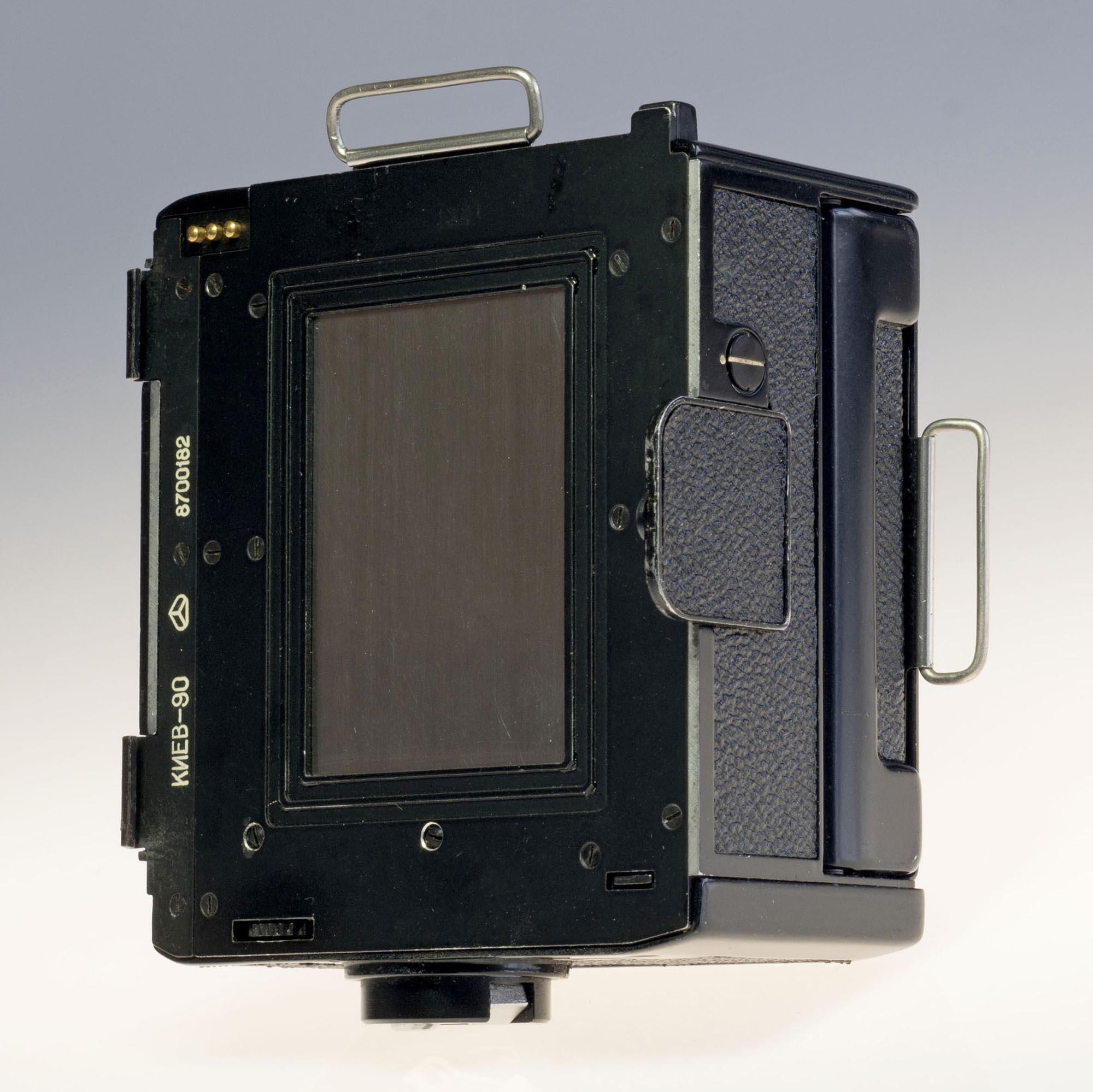
| This unusual view of the back
enables us to draw attention to various details. In the slot bottom left in this image, we can see a slot and within it a toothed wheel. This engages with a similar wheel in camera, so that when the shutter is cocked, the film is also advanced. Bottom right in this image is another slot, this time with a flat rectangular metal tab. This communicates with a similar tab on the back of the camera, to indicate (if I remember correctly from my Hasselblad and Kiev-BiG days!) whether or not the frame in the gate has been exposed. However, the main reason for taking this picture with the back on its side was to show that there are two dark slides in this back, as we can see two chrome grips, one at the top (as orientated in this picture) to remove the dark slide currently in use and one on the right in this picture, showing that a spare dark slide has been inserted into the back of this film back. This spare dark slide would of course normally be stored elsewhere, so that when the dark slide in use is removed in order to take a picture, it can be stored on the back and so not get lost. As has been standard with backs of this general design since the original Hasselblad backs shortly after the war, the shutter cannot be fired if the dark slide is inserted in the back, and the back cannot be removed if a dark slide is not in place. At the top right corner in this image, bottom left when the back is mounted on the camera, is a large black square button. Pushing this enables the back to be removed from the body, by pulling the bottom of the back away from the body, as there are hinges at the top, seen here as two wide tabs at the left of the image. On the bottom of the film back (to the right in this image) there is a small black disc with a white line, here aligned with a white dot. Nathan Dayton reports, "When the back or the supply reel is empty, the white line aligns with a white dot on the back. The disc turns slightly when you have unused film in the back. It is a nice, unobtrusive film reminder." (reference as above, p. 10) In passing, we note that significant wear from normal use is visible at various parts on the back. There must have been a time when this camera worked! |
|
 Click on image (twice if
necessary with your browser) to see it
larger.
[K90_11s.jpg]
|
 Click on image (twice if necessary with your browser) to see it larger. [K90_12s.jpg]
|
|
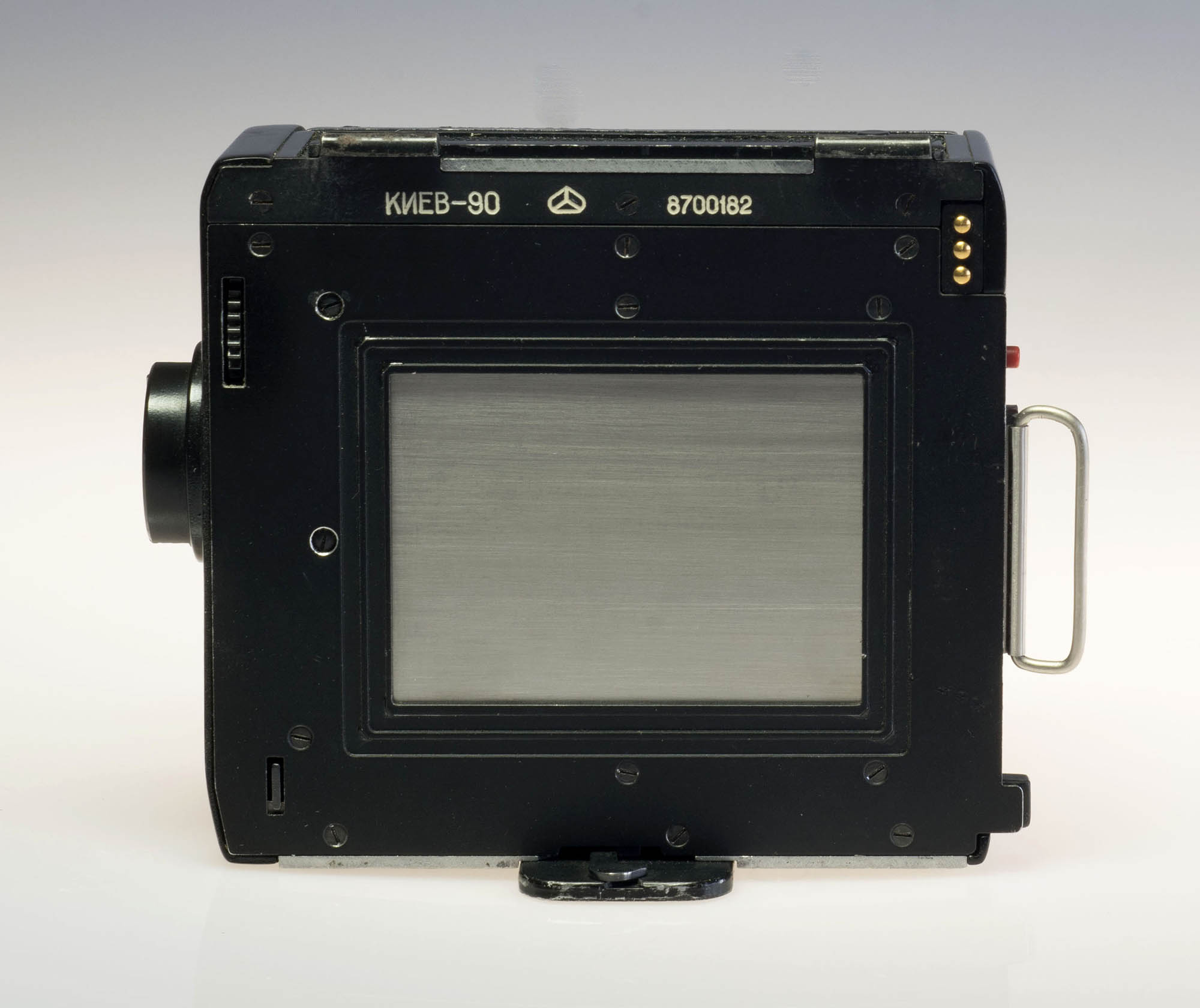
With the back in its normal
orientation here, we can see clearly many of the key
features of the back:
On the left hand side of the back (in this view) we see the film advance knob, which is used when loading the film or winding the end of the film onto the take-up spool after the last exposure, but is rarely needed for the rest of the film, which will be advanced by cocking the camera shutter, if the back is mounted on the camera at the time. On the right hand side of the back (in this view) we see the red button that prevents accidentally changing the film sensitivity setting. Below it is the chrome grip used to remove the dark slide. This can be folded flush with the body, both when inserted here and when it is in the dark slide keeper slot that is accessed from the base of the back. A latch on the top of the back, normally locked, can be slid sideways while holding down the lock release button in front of it, in order to open the camera back. It is reported (and certainly seems to be the case) that the film in the back can be removed and replaced without removing the back from the camera. |
 Click on image (twice if necessary with your browser) to see it larger. [K90_16s.jpg] |
|
This photograph enables us to
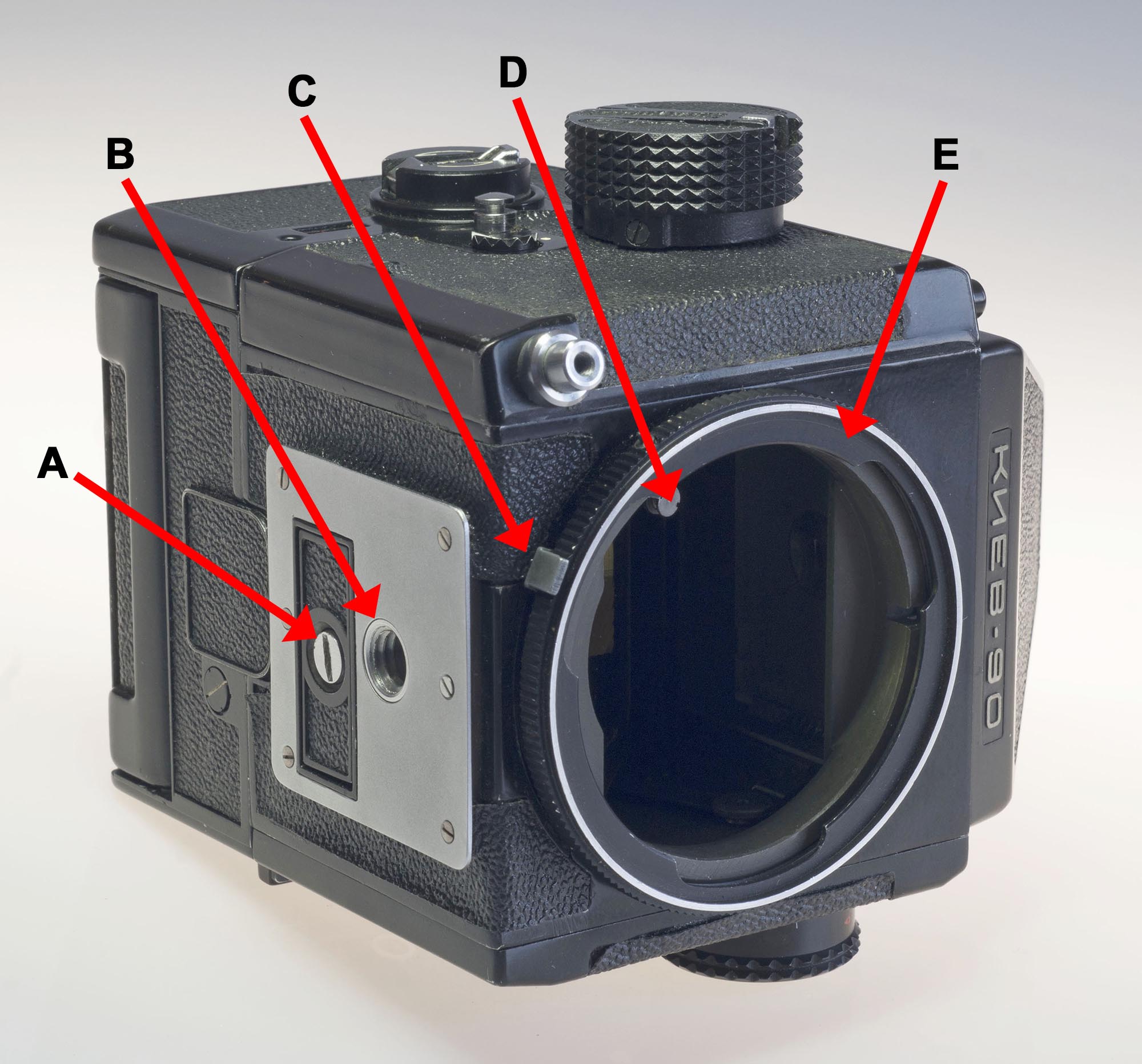
identify various components of the camera body. A: This screw, which can be removed with a small coin, provides access to the battery compartment, which requires 4 1.5V batteries (Duracell 357/303, or equivalent, apparently sometimes called SR44W or K576). B: Tripod socket. This is the larger, "Continental", ⅜" diameter. A conversion bush down to ¼" can of course be inserted if desired. C: This extra tab or "finger" will not be found on a Kiev 60 nor on a Pentacon Six. It engages with a similar tab on the Kiev 90 version of lenses, to transmit the aperture set on the lens to the camera's metering circuit, thus permitting open-aperture metering. D: This is the lever that stops down the lens to the selected aperture, when the shutter is fired. E: Here is the locking ring for the lens. It has here not been rotated to the correct position to attach the lens, which would be about a further 15º to the right. This is because it is spring loaded, to ensure that it always follows the corresponding tab on the special version of the lenses for the Kiev 90. Therefore, when putting a lens on or taking it off, it is necessary to rotate the ring further, against the resistance of the spring. This is not difficult, but the locking ring will not rest in that position if it is not held.
|
 Click on image (twice if necessary with your browser) to see it larger. [K90_20.jpg]
|
|
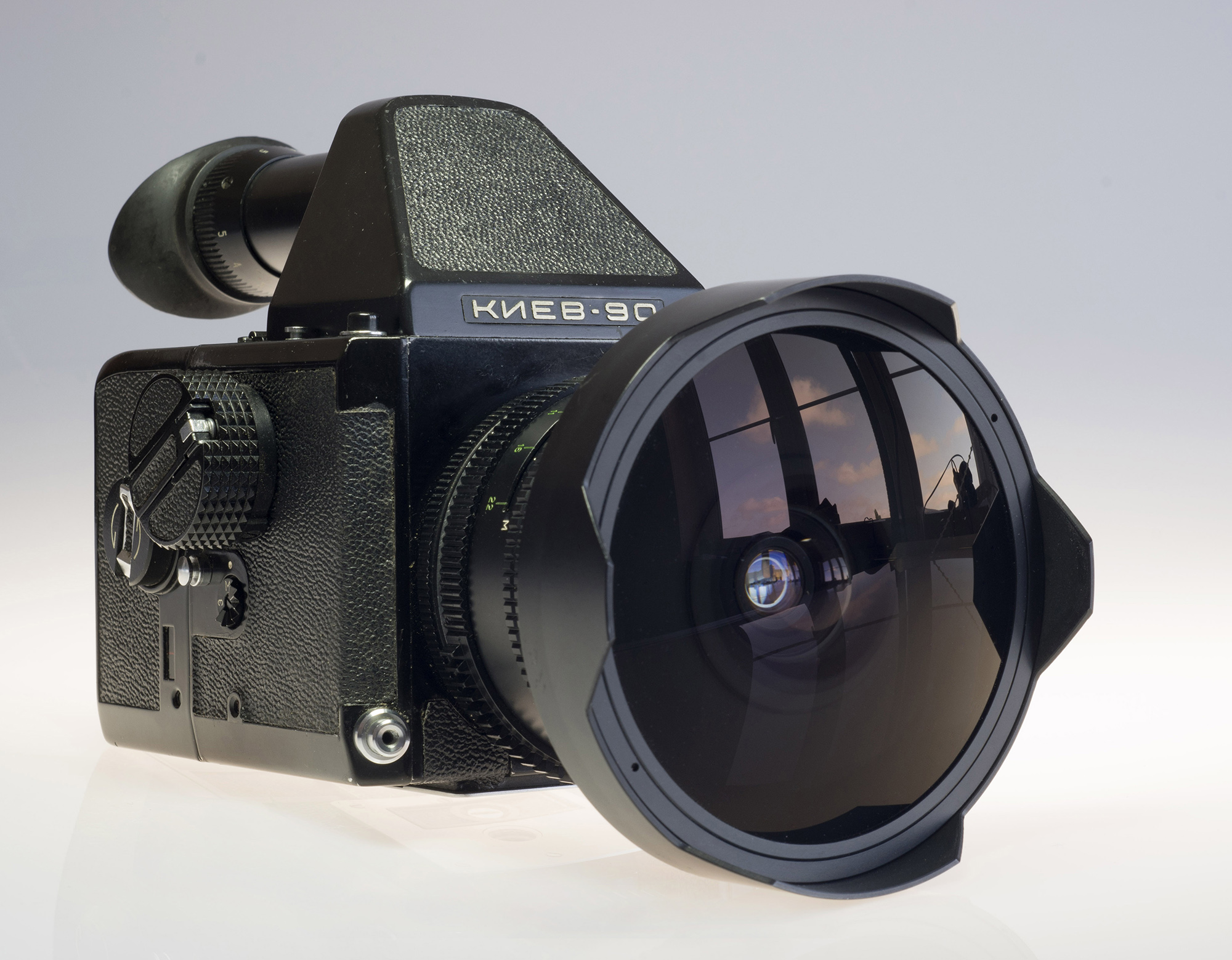
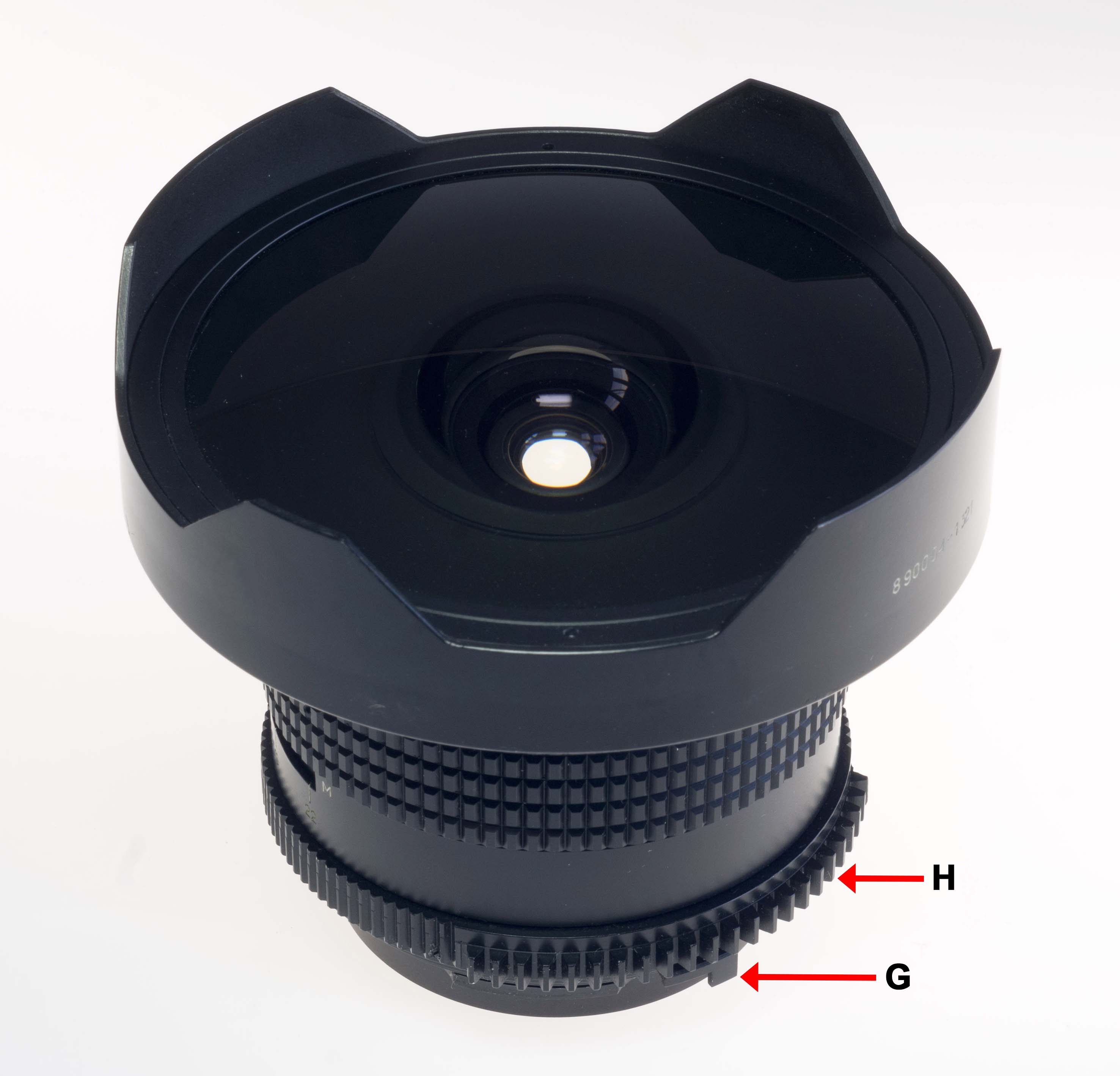
This Kiev 90 with a special version
of the 30mm Zodiak lens definitely looks glorious.
More importantly, the image seen in the viewfinder
when using this lens looks great. With the the top
and bottom of the "6×6" image format cropped down
to a nominal 6×4.5, the greatest amount of bowing
caused by the fish-eye lens, which would occur
near the edges of the image, is no longer present,
yielding a result that, with suitable composition,
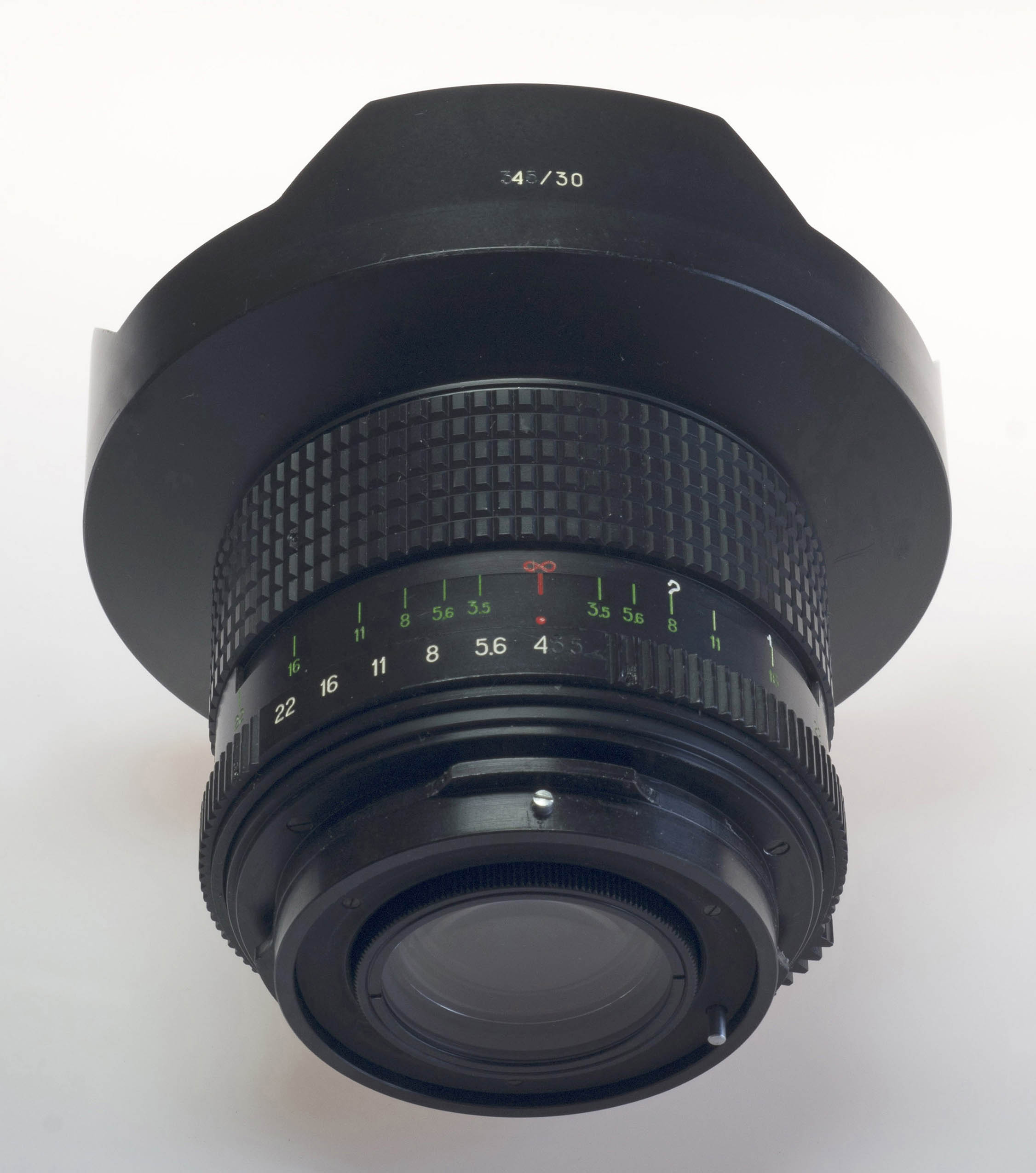
scarcely reveals the fish-eye nature of the lens. For some reason, the lens aperture is not fully open in this picture. See below!
|
 Click on image (twice if necessary with your browser) to see it larger. [K90_27s.jpg] |
|
In the image to the left here we
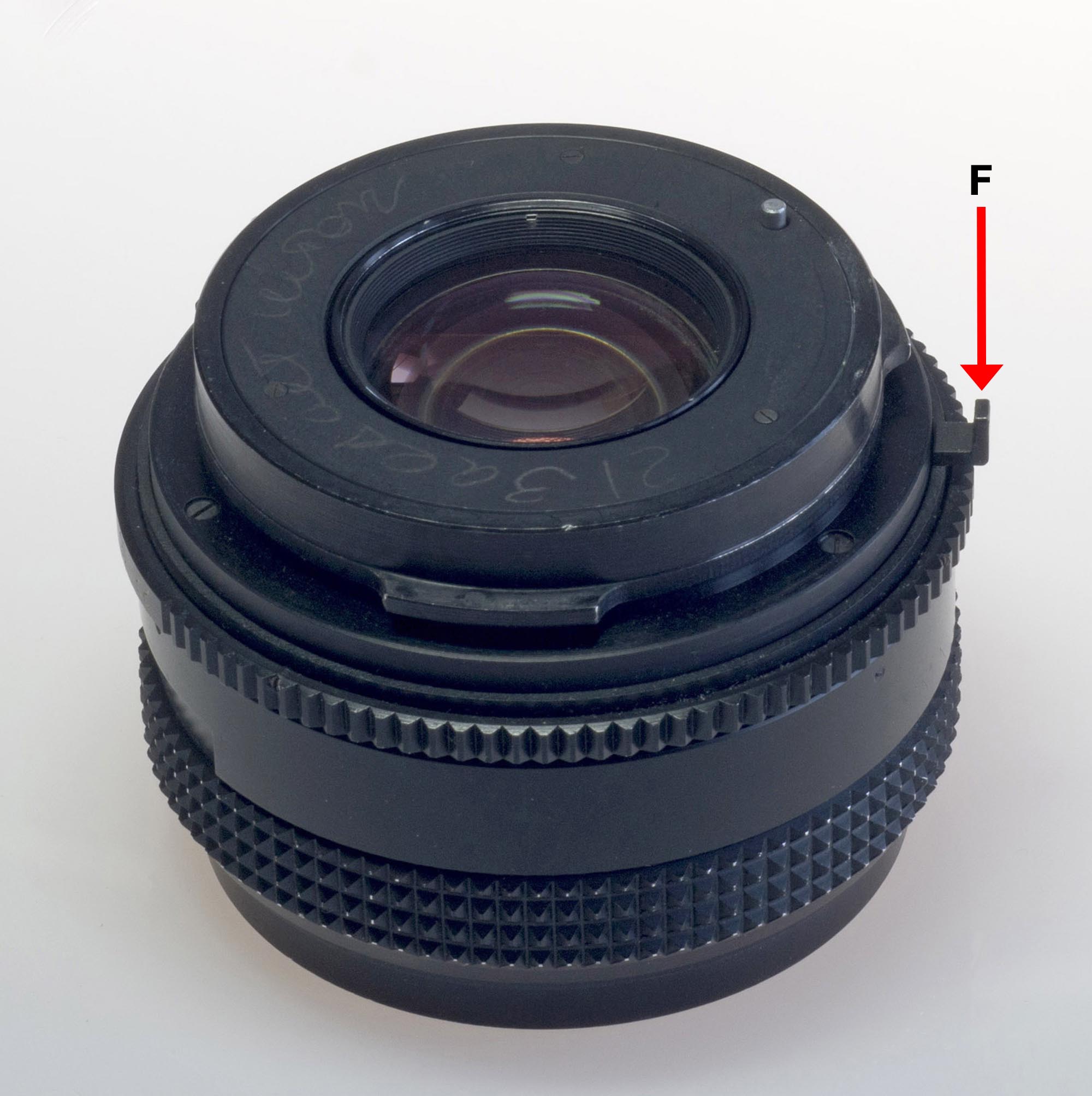
can see two details: G: This is the "finger" or tab on the lens that pushes against the corresponding tab on the camera body that feeds the aperture value to the in-built metering. H: These extra ridges have been added to about 25% of the circumference of the lens aperture ring. I don't know if they have been added in order to engage with some alternative meter coupling that was envisaged, perhaps for the subsequent Kiev 645 (see here). This lens has a serial number that dates its production year as 1989. |
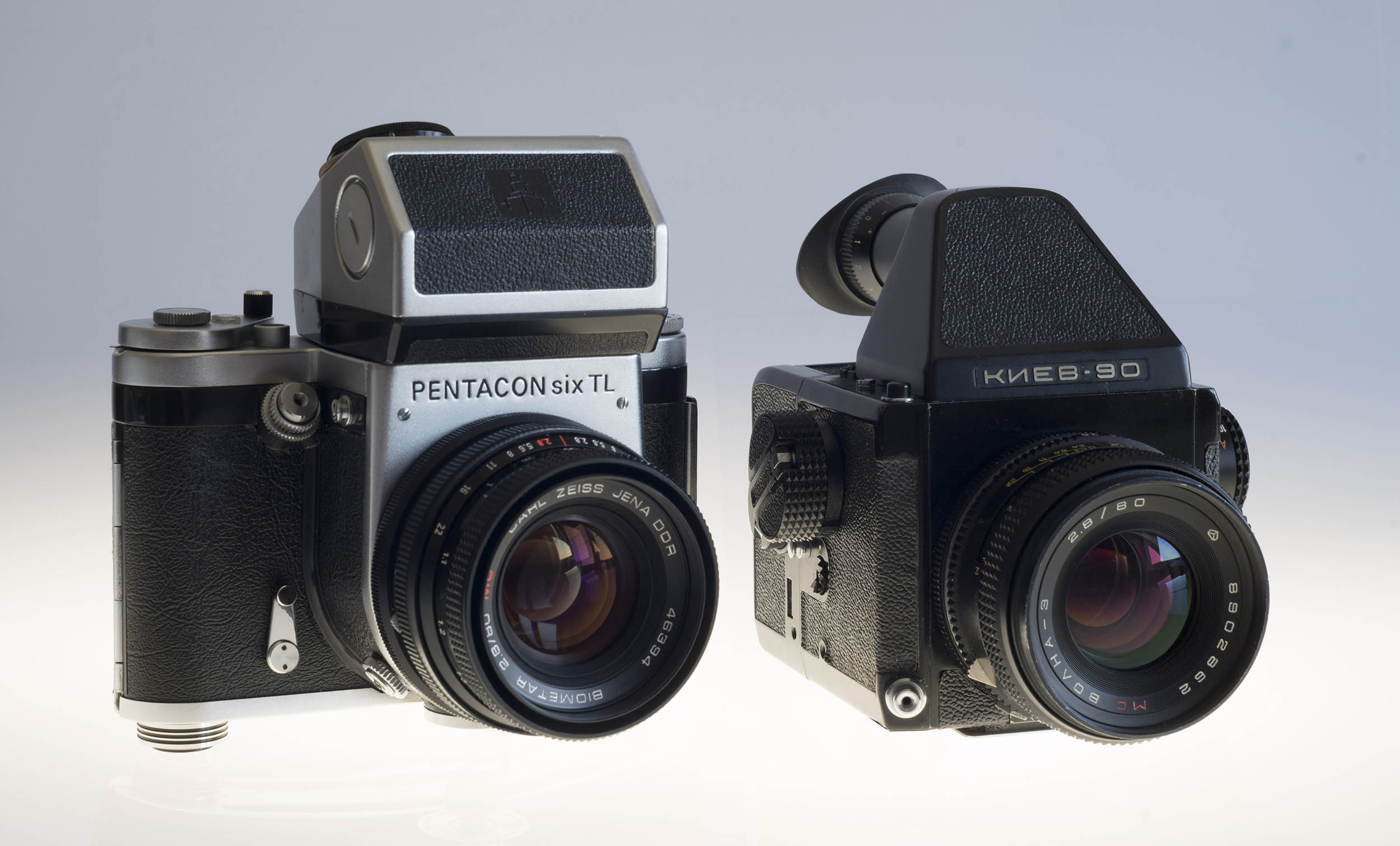
Which is better? The Pentacon Six or the Kiev 90?
Click on image (twice if necessary with your browser) to see it larger.
[P6_K90_04s.jpg]
The shapes of these two cameras are of
course totally different.
The Pentacon Six is based on the
"T-shaped" design first seen in the 1930s with cameras
such as the Noviflex (see here). Here the film feed
and take-up spools are on either side of the mirror
chamber, resulting in a camera that is wider but also
slimmer from front to back.
The Kiev 90 is based on the box design
that was particularly made popular by Hasselblad after
the Second World War and for the next 50 or more years.
In this shape the film feed and take-up spools are
behind the area of film that is exposed, so the film
doubles back on itself before reaching the gate, and
then again after leaving the gate. So in this design the
camera is not as wide, but it is much deeper from front
to back.
Contrary to the claims made by some in
favour of one design or the other, with both systems the
cameras achieved maximum film flatness and so equal
image sharpness with equivalent lenses.
Both camera shapes can be held
comfortably in the hand and operated.
One surprise for me about the Kiev 90
reviewed here is how heavy it is. It shoots a smaller
format image than the Pentacon Six, 6×4.5 instead of the
6×6 obtained with the Pentacon Six, so the Kiev 90 body
is not as tall as the Pentacon Six, and the Kiev 90 is
also narrower from side to side than the Pentacon Six,
so one expects it to be lighter. (Because of the film
path, it is of course a lot deeper than the Pentacon
Six.) Listed weight for the Kiev 90 is 1.5 kg. On my
non-scientific but pretty accurate home scales, with
standard lens, pentaprism, 120 film back with film
loaded and four batteries, lens cap but no filter, this
camera weighs 1Kg 630g or 3lb 9½ oz, just 2½ or 2¾ oz
lighter than a Pentacon Six with standard lens, metering
prism, battery, film, filter and lens cap, which comes
out today at 1Kg 705g (3lb 12 oz), just five grams or a
quarter of an ounce less than a Pentacon Six weighed on
other scales about 20 years ago (see here).
The Kiev 90 shown here may be viewed by
some as a thing of beauty and a desirable display item,
but for me, and I suspect for anyone else who uses
cameras to take actual photographs, the Kiev 90 does not
make me smile, because taking photographs with it is
impossible.
The many Pentacon Six cameras that I have
owned over nearly five decades have
worked reliably and have never let me down. After
looking for a Kiev 90 for 15 or 20 years, I finally
found this one, described as "in full working order".
How the vendor could have made that mistake I cannot
understand. Since the day that it arrived it has not
worked and in more than a decade of trying I have been
unable to find anyone who could repair it, even in its
birthplace, Kiev.
It should have been a great camera.
Unfortunately, it is not. It might have become the best
camera with the Pentacon Six lens mount ever. However, its
inherent grave problems resulted in very small
production runs and the end of production, and it was
never officially available outside the Soviet Union, as
far as I can discover, in spite of being displayed in
international trade fairs.
| A note on how
the pictures on this page were taken The photographs on this page were taken by me using a Novoflex MagicStudio table, translucent panel and lights. Two lights were under the panel, while one above the subject lightened shadows, and there was some general light from the window. The lights have a colour temperature of 5600ºK, so there was no mis-match of colour temperature between them and the daylight. To go on to the page in the history section on the Kiev 90 and the Kiev 645, click here. To go to the beginning of the history section, click here. To go to introduction to the cameras, click here. To choose other options, click
below. © TRA This page first published: July 2026 |
|
 [LightTable_s.jpg]
|